


Description
Author: Henry Ward Beecher
Publisher: Henry Altemus
Place: Philadelphia
Year: 1892
Edition: 1892 Henry Altemus edition
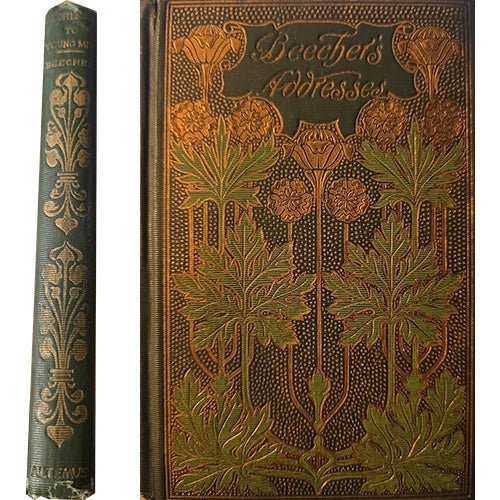
Format: Decorative cloth hardcover
Page Count: 257
Condition: Very Good for its age. Exceptionally clean and vivid green decorative cloth binding with elaborate gilt and green floral ornamentation. Gilt remains notably bright. Light rubbing and small areas of wear at the spine ends, minor age-toning, and a few marks consistent with a book of this age. Pencil notation appears on an endpaper. Illustrated pages and text remain clean and well preserved. Please review all photographs.
Description
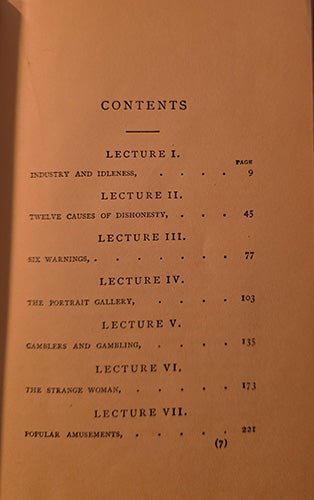
Published in 1892, this handsome Victorian edition of Addresses to Young Men presents seven moral and practical lectures by Henry Ward Beecher, one of the most famous—and controversial—American religious figures of the nineteenth century.
Beecher was a prominent Protestant minister, celebrated public speaker, social reformer, and outspoken opponent of slavery. He served for approximately forty years as the pastor of Plymouth Church in Brooklyn, where his dramatic and conversational preaching attracted enormous audiences. His congregation raised money to purchase the freedom of enslaved people, while Beecher also supported women’s suffrage and other reform movements. He was the brother of Harriet Beecher Stowe, author of the landmark antislavery novel Uncle Tom’s Cabin, and a member of the influential Beecher family of ministers, writers, educators, and reformers.
Beecher addresses the formation of character through such subjects as industry, idleness, dishonesty, temptation, gambling, relationships, and popular amusements. Although written for young men in the nineteenth century, the lectures offer a revealing portrait of Victorian American values and the social concerns facing young adults during the period.
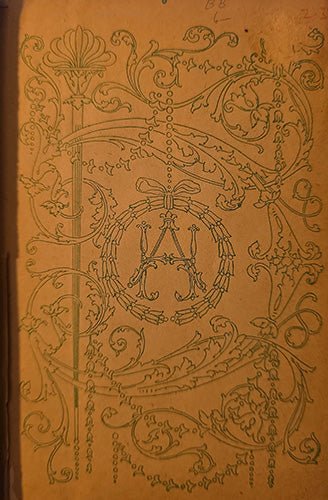
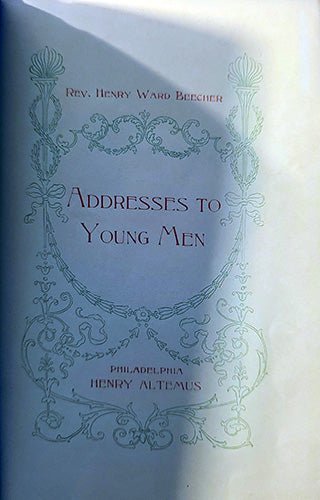
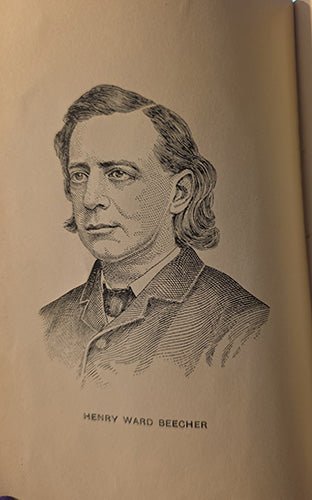
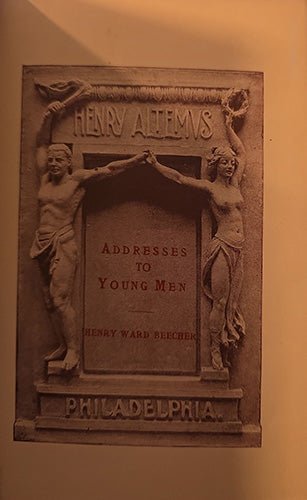
This edition was published five years after Beecher’s death by Philadelphia publisher Henry Altemus. It includes an engraved portrait of Beecher, an elaborately illustrated title page, decorative endpapers, and an unusually vivid green-and-gilt floral binding.
Why we love this book
The ornate Victorian binding is the true distinction of this copy. Its deep green cloth, bright gilt decoration, stylized flowers, and illustrated interior make it especially appealing as both a historical work and a display book. Beecher’s place in the abolitionist movement, his relationship to Harriet Beecher Stowe, and his enormous influence upon nineteenth-century American religious and public life give the book additional historical interest.